
Notion as a CRM — where it genuinely works, and where it structurally cannot
Notion is a far better CRM than people give it credit for, right up until you need it to do something rather than record something. Here is the honest line between the two.
A lot of one-person businesses run their pipeline in Notion, and most of the advice they get is some version of "that's cute, get a real CRM."
That is lazy. Notion is genuinely good at this, better than a spreadsheet in ways that matter, and for a large number of people it is the right answer. It also has one structural limitation that no amount of clever database design fixes.
I build a CRM, so read this knowing that. I have tried to write the version I would want if I were the one with a Notion setup I had spent a weekend on.
Where Notion wins
It is a real relational database. Contacts related to Companies related to Deals, with rollups that actually calculate. That is not a spreadsheet with extra steps — it is the data model a CRM uses, and you built it yourself in an afternoon.
Views are free. The same records as a kanban board, a calendar, a filtered table, a gallery. Most CRMs charge for this or make it a settings page. In Notion it is a click, and you can have as many as you like.
Documents live with the data. This is the thing Notion does that almost no CRM does well. A contact record that is a page, with meeting notes, a proposal draft and a call transcript inside it, is genuinely better than a CRM's cramped notes field. If your work is thinking-heavy — consulting, strategy, anything where the artefact matters as much as the relationship — this is a real advantage.
It bends exactly to your business. No arguing with someone else's idea of what a deal stage is.
It is already where your other work lives. One tool for wiki, docs, projects and pipeline has a real cost saving and a real context saving.
Anyone telling you this is a toy has not used it properly.
Where Notion breaks as a CRM
It cannot send anything. This is the whole thing. You cannot email a contact from their record, cannot text them, cannot fire a sequence. You look at the record, switch to Gmail, find the thread, write the message, come back, and type a note saying you did.
Nothing lands in it. The reply arrives in your inbox, not on the record. Which means the record is only ever as current as your discipline, and history lives in three places — your inbox, your phone, and a Notion page containing your summary of both.
It cannot react to the outside world. Notion has reminders, recurring templates and some automation these days — but all of it runs on Notion's own data. There is no "follow up in five days unless they reply", because Notion has no idea whether they replied. The reply happened in your inbox, which Notion cannot see. So every follow-up still depends on you noticing.
No deduplication. Import the same list twice and you have everything twice. There is no concept of "this is the same person."
Mobile is a document app. Fine for reading, poor for the actual mobile use case — someone rings, you need their history in four seconds, standing in a car park.
You own the maintenance forever. Every schema change, every broken relation, every formula that stops working when you rename a property. A Notion CRM is not a tool you adopted, it is a product you built and now maintain, and that bill arrives quietly every time you want to change something.
It gets slow. A few thousand rows with rollups and filtered views is noticeably sluggish in a way a purpose-built database is not.
The line, stated plainly
Notion is where you write things down. A CRM is where things happen.
Everything above is a version of that. If your relationship with your contacts is recording — you meet them, you think about them, you write up what happened — Notion is excellent and I would not switch.
If your relationship with your contacts is reaching them — sending, chasing, scheduling, following up on a cadence — then you are using a filing cabinet to do a job that needs a telephone.
I wrote the more general version of this in when a spreadsheet stops working as a CRM. The signals are the same. Notion just gets you considerably further before you hit them.
What Groundbase does differently
The short version: it acts.
Email and text go out from the contact's record, through your own email account and your own Twilio, and the reply comes back and attaches itself to that contact. History accumulates because it happened, not because you wrote it down afterwards.
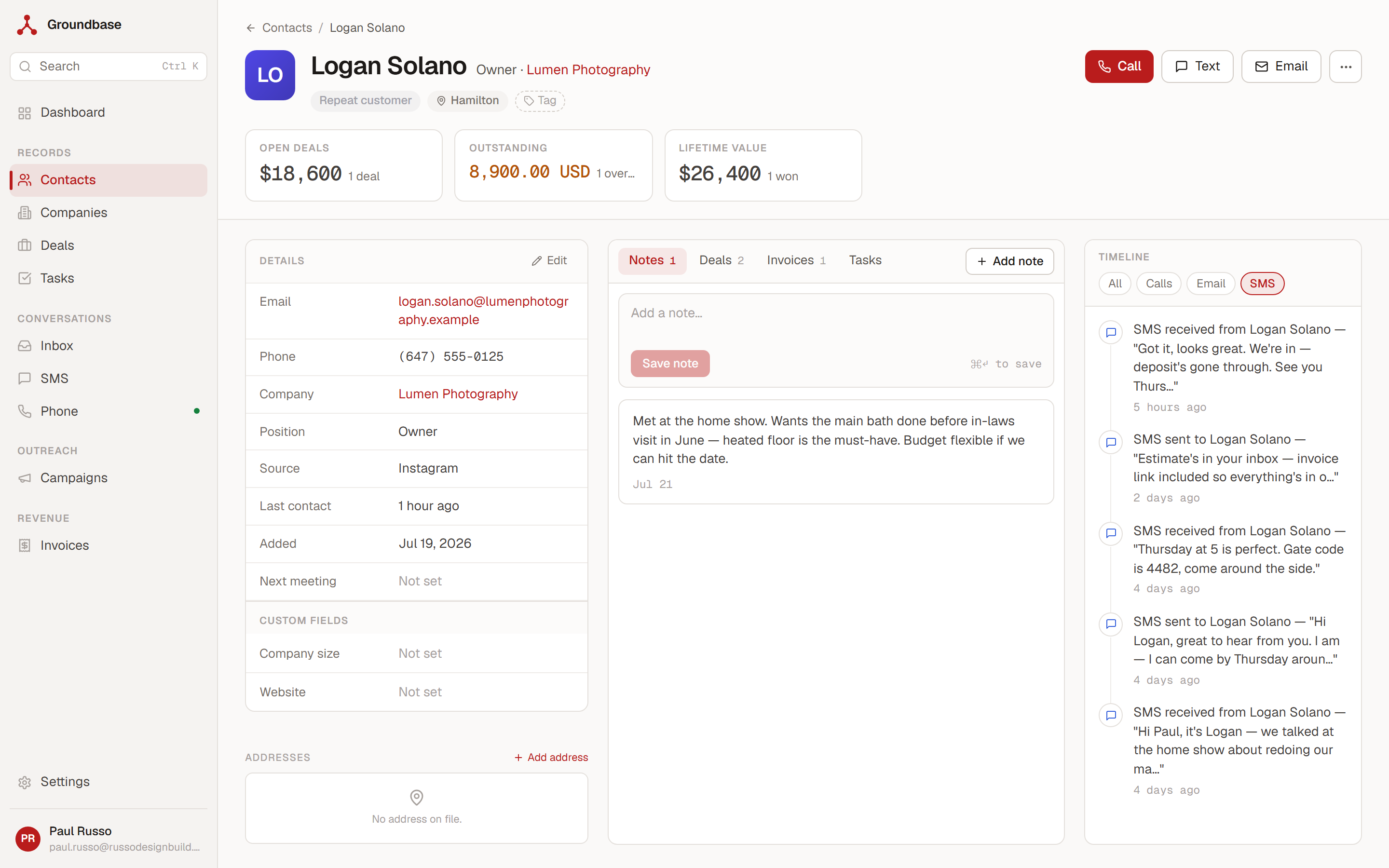
That screenshot is the whole argument. The messages are on the record because they were sent and received there, not because anybody wrote a summary afterwards.
A campaign that stops when someone replies is the difference in one line. It requires knowing a reply arrived, which requires the messages living in the same system as the contacts.
Deals move through stages that trigger things. Booking links show your real availability. Invoices go to the contacts already in the system, and receipts send themselves.
And because it is one database rather than a document graph, "who have I not spoken to in a month" is a query rather than an afternoon.
What Groundbase does not have
Being straight, because this is where most comparison posts stop being useful:
No documents. No pages, no wiki, no nested toggles, no writing surface. Notes are notes. If a big part of your value is written artefacts, Groundbase does not replace Notion and is not trying to.
Less flexibility. Custom fields and custom deal stages, yes. Arbitrary schemas and formula properties, no.
Not a team workspace. Groundbase is built for one person. If you need shared docs and handoffs, that is not what this is — see who Groundbase is and is not for before you trial it.
Fewer views. Table, kanban, calendar for the things that suit them. Not Notion's endless flexibility.
Using both is a legitimate answer
This does not have to be a switch, and for a lot of people it should not be.
Notion for what Notion is best at — docs, project work, your wiki, the thinking. A CRM for the pipeline, the messaging and the follow-up. The overlap is smaller than it looks: a proposal lives comfortably in Notion, while the eleven texts chasing a signature belong somewhere that can send them.
The failure mode to avoid is maintaining contact records in both. Pick one place where a person's details are true, and let the other link to it.
The actual decision
Stay in Notion if your contact list is a reference you consult, your outreach is occasional and personal, and the documents matter more than the messages. You will be fine for years, and you will keep the flexibility.
Move if you are forgetting follow-ups, your history lives in your inbox rather than your records, or you have started wishing the database could do something. That wish is the signal. It never goes away, and no amount of rebuilding the schema satisfies it.
Try both if you are unsure. Keep Notion for docs, run the pipeline elsewhere for a month, and see which one you open first when someone calls.
One practical note if you do move: bring contacts, not history. Rebuilding two years of notes into a new system is how migrations get abandoned in week two.
Running a Notion CRM and not sure whether you have outgrown it? Describe the setup and I will tell you honestly: blog-notion@groundbasecrm.com — I read every one.
Built by a solo dev. Try it.
Start your 14-day trial →More from the Pipeline
Free offline CRMs for Windows (2026): what's out there and what each one needs
Most "free CRMs" are a website with a free plan, a user limit and a contact cap. If you want one that runs …
Can Groundbase replace QuickBooks for invoicing? Yes, for invoicing. Not for the books.
If you pay QuickBooks Online mainly to send invoices and get paid, Groundbase does that job inside the CRM …
Bill your hours without retyping them
Track time with a timer or log it after the fact, let the hourly rate remember itself, and put the unbilled…
Quotes with a deposit: price the job before you invoice it
A quote in Groundbase is a priced offer the customer accepts online, optionally by paying a deposit through…